
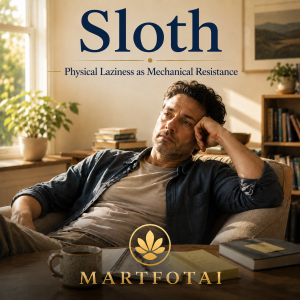
S02/E24: Sloth: Physical Laziness as Mechanical Resistance
Full Episode Summary
Sloth is examined as the moving centre’s refusal pole: the same mechanism that over-discharges as reactive speech in E23 under-discharges here, declining necessary movement in favour of its own organic comfort-preference. The governing claim runs through the whole episode: the body makes its case, continuously and convincingly, for remaining exactly where it is.
The body is described plainly as an animal, functioning correctly according to its own design: it seeks food, rest, and the avoidance of unnecessary effort, and nothing else. The only live question is which direction authority runs, whether the body commands the person or the person commands the body. Inertia is distinguished from laziness: inertia is the mechanical continuation of whatever pattern already exists, effortful or restful, and requires a deliberately applied force to shift it at all.
Self-calming is named as where an unchallenged sloth eventually leads: a state that presents as rest while the machine continues running at full expenditure, with no voluntary direction anywhere in it. Left to deepen, the range of available response narrows over years, a progressive flattening the episode calls, without drama, the shape psychological death actually takes.
Super-effort is introduced as the deliberate crossing of the body’s own stopping-signal, calibrated to eleven or twelve minutes, requiring all three centres moving in the same direction against the body’s explicit resistance. The practical aphorism that follows compresses the whole episode into five words: like what it does not like.
The episode closes on the line that opened it: the body settled, the work remained.
In this episode, you will hear:
- The body as animal: why the body functions correctly according to its own design, and why the only real question is which direction authority runs
- Inertia versus laziness: why inertia protects whatever pattern already exists, effort or rest, and requires deliberately applied force to change
- Self-calming: the state sloth deepens into when left unchallenged, and the honest test for telling it apart from legitimate rest
- Super-effort: the deliberate, calibrated crossing of the body’s own stopping-signal, and why it requires all three centres at once
- Like what it does not like: the compressed practice of voluntary discomfort, and the distinction between voluntary suffering and self-punishment
- The incremental counter-action and The Unmoving Hour: two ways of working directly with the body’s case for comfort
- How this episode extends E23: the same moving centre, now refusing rather than discharging
Who this episode is for
Anyone who has noticed the body arranging itself for comfort and quietly deferring the thing that actually needed doing.
Anyone who has mistaken constant busyness for genuine effort, or genuine rest for a body that simply got its way first.
Anyone who wants a precise, practical way to tell the difference between real depletion and the body’s strategic case for stopping.
Practice of the Week: Three Ways to Work Against the Body's Case
Three practices for working directly with the body's mechanical case for comfort, plus the law that governs all three: push and pause. Begin with the incremental counter-action this week.
The full practice is available to Path 1 members and above.
Already a member? Log in to access this content.
Join Path 1 Log InPodcast Transcript
This content is available to registered members.
Join Martfotai