
S02/E09: Formatory Thinking – The Binary Mind
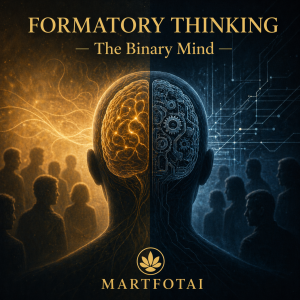
Full Episode Summary
Every assessment produces a verdict before any examination has taken place. This episode maps the mechanism responsible: the formatory apparatus, a mechanical function distinct from the intellectual centre, which retrieves rather than thinks and produces its output with the authority of a conclusion.
Three built-in characteristics are traced. The apparatus reduces everything into two opposing positions. It operates in extremes, with no access to the conditional or partial. It tends to produce the counter-position to any assertion it encounters. Together these generate a closed loop capable of running indefinitely without genuine information entering or leaving.
The episode then examines what the apparatus thinks with. Every word carries the specific associations of the person hearing it. Two people can use the same word and activate entirely different inner content. Gurdjieff’s distinction between thinking in words and thinking by form shows why precision of language alone cannot resolve this.
A core distinction follows between knowledge stored in one centre and understanding verified across two. The apparatus generates the first as standard output. Its contents cannot hold under pressure or survive a change of state.
A prior problem compounds this: the binary sorting runs on material that was never accurately received in the first place. Impressions arrive half-registered, already matched to the nearest available category. The mechanism sorts not what happened, but a misregistered version of it.
The episode closes with the cost in the work itself. The apparatus accumulates work-related labels with the same absence of genuine content as any other category. Nicoll’s distinction between formatory memory and Work-memory provides the test for what has actually moved and what has not.
In this episode, you will hear:
- What the formatory apparatus actually is and why its output is experienced as thought
- Three built-in operating limits and what they produce together as a closed loop
- Why word-thinking retrieves associations rather than pointing to direct experience
- The distinction between knowledge stored in one centre and understanding verified across two
- The prior problem of misregistration: why the binary sort runs on material it has not accurately received
- Why the apparatus holds its grip when the work begins, and Nicoll’s test for distinguishing formatory memory from Work-memory
- Three practice moves: the reconstruction test, genuine listening, and holding the question open
Who this episode is for
Anyone who has used the vocabulary of this work fluently and then, in a moment of genuine difficulty, found it unavailable. Anyone who has defended a position and later found, on reflection, that it arrived fully formed before any consideration took place. Anyone who has studied sincerely for years and still finds the same reactions arriving in the same situations. The apparatus has been running throughout. This episode makes the mechanism visible.
Podcast Transcript
This content is available to registered members.
Join Martfotai